Sustainable Success: Creating the Conditions for Student Leaders to Thrive

With over 60 clubs and organizations active at SFS, the school leadership is responding by building robust systems to promote balance and sustainability.
When Angela Son first stepped into the Clubs Coordinator role at Seoul Foreign School three years ago, she saw something special: an opportunity to view students in a different light. As a high school counselor focused on providing personal and social-emotional support for students, Angela is familiar with the pressures facing high-achieving students in international schools. The coordinator position offered her a chance to empower those same students flourishing in their element, pursuing passions, and growing as leaders.
"I also enjoy having students see me in a different way," Angela reflects. "Students who come into my office are not only seeking support for their concerns, but they are also looking for opportunities to grow as a leader.’”
Protected Time, Protected Growth
SFS is home to over 60 student clubs and organizations, a number that requires thoughtful infrastructure. One of the most significant structures of support is deceptively simple: two dedicated club days built directly into the six-day timetable rotation, during lunch periods rather than after school.
"Because of that built-in timetable, the students have that protected time in order to run their meetings," Angela explains. The school also sets limits to prevent overcommitment, ensuring students are not stretching themselves too thin or skipping lunch break.
This attention to balance reflects Angela's dual perspective as counselor and coordinator. "I feel privileged to be able to know the students and also cultivate their commitments through our management systems. We can ask, ‘how do we lessen the stress that's happening because of a lack of a certain guardrail? How can we help grow their potential by building in parameters?’”
Expanding Opportunities through the Advisory Board Model
Among the structures Angela advises the Clubs and Organizations Advisory Board (COAB), a group of 14 students who help run the protocols that keep 60+ clubs functioning smoothly. Event proposals, fundraiser processes, venue coordination, guidelines training: the students themselves lead these systems.
"They get to experience the systemic side of supporting student organizations ," Angela notes. "They are also on the ground level as general club members and executives themselves so they understand how the protocols impact students in different ways. This allows them to balance multiple perspectives when they hold leadership training sessions for their peers and create protocols for student clubs.
The school has designated seven "Official Functions of School" (OFOS) groups, including COAB, Student Council, Sports Council, Publicity Council, Arts Council, Ambassadors, and National Honor Society, whose work impacts the entire student body. For these high-commitment roles, the school has established clear parameters: executives cannot hold leadership positions in more than one OFOS organization.
"Sometimes that limit has disappointed some students," Angela acknowledges. "But it's a life lesson where students are learning how to focus, go in-depth and really hone in on their roles and responsibilities for now. It doesn't mean that the other doors are closed forever."
The Summit: A Real-world Workshop for Skill Development
This year, Nancy Calimlim, who coordinates high school activities and advises the Student Council, approached Angela with an idea: a leadership workshop for student leaders. Angela saw an opportunity to create something distinct. Since a Club Leadership Retreat already existed for all student executives, she proposed focusing this new initiative specifically on OFOS leaders—a summit that would offer something unique for those whose work impacts the entire student body.
Together, they brought the concept to their fellow OFOS advisors, who agreed to join the effort.
Nancy had long observed capable student leaders who could benefit from intentional skill development. "Many of our students are really, really capable leaders," she explains. "The leadership interest is inherent. The basic skills are also there. But it looked like we needed to develop those skills. I wanted to offer tools to enhance what is naturally already in them."
For Nancy, this vision extends beyond SFS. Drawing from her own formative experiences as a student council president, she sees leadership development as preparation that transcends school walls. "These are skills that these students will take with them, not just in university but when they start understanding the reality of the world at a deeper level. This leadership capacity is really going to help them face whatever challenges they have."
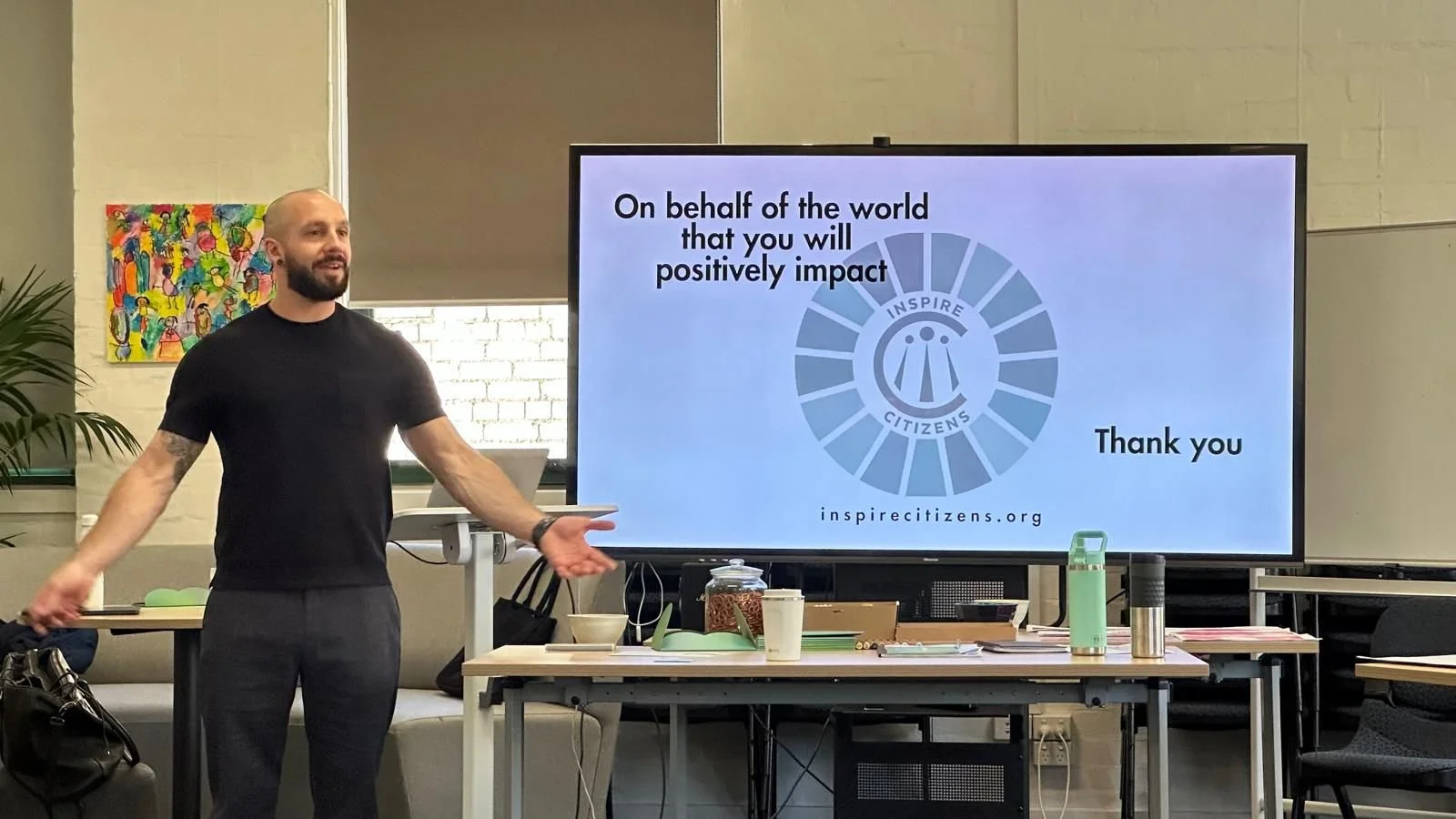
Aaron Moniz, co-founder of Inspire Citizens, has been a vital thought partner and collaborator in the emerging model of student leadership at SFS.
Getting Value from a Thought Partnership with Inspire Citizens
The summit concept benefited from specialized expertise. Aaron Moniz of Inspire Citizens served as a thought partner throughout its development. Nancy credits Aaron as her first collaborator on the project.
"The very first person that I approached was Aaron," Nancy recalls. "I got inspiration from him. He allowed me to go through his slides, to go through his notes from leadership summits in other schools. I was able to take in whatever I thought would be helpful for our students here at SFS."
From those conversations, Nancy distilled a clear framework: begin with a vision and mission statement tied to learning outcomes, identify topics requiring mentorship, and build a schedule that connects every element. "Having those three, I was able to project how many speakers we would need, who we would invite, and which student leaders would participate. That's the backbone of the summit, and Aaron was there helping me put all those things together."
Angela credits Aaron with reinforcing the value of intentional check-ins beyond the summit itself. "He taught me a lot about the importance of not just holding workshops for students but also building in intentional checkpoints throughout the year," she shares. "That accountability is not intended to be burdensome but rather convey the message that, 'we're here to support you, gauge how you are doing as leaders and as individuals, and walk alongside you in your journeys.
Aaron's workshops at regional conferences have directly shaped the approach to executive training, particularly the practice of connecting every activity back to mission and purpose. "What I've learned from Aaron was the value of tying in those pieces in every lesson, training, and workshop, reminding students of their original passion and purpose: 'why are we doing this?'"
A Partnership That Models Leadership
The summit's success relied on a complementary partnership between Nancy and Angela. The duo set about getting buy-in from the students through the OFOS advisors then turned their attention toward designing the content and recruiting mentors. What remained was to activate logistics: equipment, materials, lunches, scheduling, and facilities.
"That partnership alone provided a good model to the students," Nancy reflects. "Both of us are leaders in our own organizations. At the same time, we know how to give way. We also know how to collaborate—one person takes a step back while another steps forward, or both work side by side. What we are doing is also modeling the right behavior, the right attitude for our student leaders."
A Surprising Turnout

The summit exceeded expectations in ways that surprised even its organizers. Previous leadership workshops had attracted fewer than ten students. This time, thirty-seven signed up—and thirty-six attended.
Part of that enthusiasm stemmed from an unexpected development. Through the help of SFS Communications Director, Ah Young Chi, Nancy and Angela approached one Board of Governors member to serve as keynote speaker. That board member spread the word, and suddenly five governors wanted to lead workshops on topics from ethical decision-making to conflict resolution.
"When we started promoting this to the students, they were like, 'Oh, it is that important,'" Nancy recalls. "So important that even the Board of Governors are the workshop leaders. That made them feel more important and more special. The real leaders of the school are the ones delivering the summit."
The impact was immediate. Nancy observed students applying their new tools to meetings within weeks. All five board members have already volunteered to return next year. What began as an internal initiative is gaining traction as it heads toward a more widely inclusive event with increasing potential for impact in the region.
Student Voices from the Leadership Summit
For students serving on the Clubs and Organizations Advisory Board, the summit offered both practical insights and perspective shifts. Andie Y., co-president of the board, found one concept particularly liberating: "At the leadership summit, one of the most interesting things I learnt was that you aren't necessarily confined to one leadership type and can be flexible per team or situation to best adapt to the given circumstances. The idea that leading is somewhat systematic and analytical brought ease to me as I had thought that leadership was a grand capability that you either have or don't."
Student leaders also emphasized how much they learn from one another in their day-to-day work. Emery S. describes her approach: "I try to improve my leadership skills by observing those in my team that have more experience in the group, taking note of their ways of initiative and their processes. I try to learn from them so I can utilize those strategies in my own leadership."
For Caitlin K., the summit reinforced a foundational principle: "One big takeaway concept I took away from the leadership summit was that strong leaders begin with empathy. During lectures, I learned that empathy allows leaders to communicate more effectively and support the community."
Distributed Effort Leading to the Next Level
The structures at SFS represent years of intentional development, but both Angela and Nancy are quick to credit the collaborative team of faculty advisors who share the work. This theme of marshalling the efforts of coordinators, advisors, administrators, board members, and external facilitators seems to be the key to creating a supportive environment that promotes sustainable student leadership throughout the school community.
Nancy sees the summit as the beginning of a new tradition—one that extends beyond high school students to involve the broader community. "This leadership summit would start a really good tradition," she says. "Not just a thing for high school, but something in which the bigger community is involved."
Plans are already forming for a spring check-in with OFOS leaders and the possibility of expanding the summit to include neighboring international schools. For Angela, the vision is broadening: "I like the idea of developing inter-school connections to explore similar roles. Student leaders will be able to network and ask, 'how can we help each other to meet the needs of our student bodies?'"
For Nancy, that ambition was there from the start: "I wanted to offer it not only to SFS, but to international schools in South Korea, and then perhaps branch out to invite other international schools from Asia or from all over the world."
When leadership development becomes embedded in school culture—protected by structures, enriched by partnership, and modeled by adults who themselves know how to collaborate—student leaders don't just survive. They thrive.