
Voicemails to Nature: How two primary teachers grew an eco-conference at the International School of Paris
Want to listen in to the voicemail that a young learner at ISP left for this tree?
Under the trees of the Bois de Boulogne, students from the International School of Paris spread out with cameras and recorders. Some were eleven years old but some were as young as just three.
"They were leaving voicemails to nature," Educator Heather Semon says. "It was the cutest thing. So they were like, hello little flower, I love you so much, you are so beautiful, I love your colour."
That afternoon in the woods closed the first primary edition of ISPEC, the International School of Paris Environmental Conference. ISPEC itself is not new. It began with high school students roughly twelve years ago, grew out of the school's Eco-Schools work, and was, in Heather's words, "inspired by COP,” referring to the Conference of the Parties, the annual global climate summit hosted by the United Nations. What was new was that the school's youngest learners finally had a version of their own.
The initial wave of interest emanated from an intra-school visit. Heather brought her primary action team to the high school conference as guests. They watched older students present, they saw a film about turtle research and they heard an environmental scientist visiting from South Africa. "They asked, ‘can we do this too?’”
Scaling enthusiasm
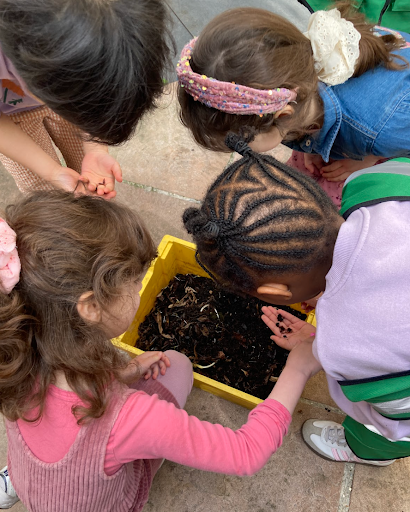
Young learners at ISP are learning lots and getting messy as they consider elements of our ecosystems. It turns out that worms are our friends!
Heather had started the primary Action Cubs with posters and eleven children. "I literally just put up posters in the school. And said, hey, who loves the earth?" The Action Cubs met before school on Thursdays and grew through assemblies, videos and homeroom conversations. "Our whole mission was to inspire tiny daily actions—little tiny things that we can do as six, seven, eight year olds— that everyone can do, and if you do that too, wouldn't that be making our school a better place, and in turn our community a better place, and hopefully our world a better place?”
Then she recruited Dan Shrewsbury. Last year the two of them reignited Eco-Schools as a whole-school club running from grade four to grade twelve, and in one of the eco-committee meetings a student said the school should have an eco day. "Myself and Heather looked at each other and said, okay, there we go. That's our in," Dan says.
They invited Sophie Peccaud from Inspire Citizens, who was already in orbit supporting the school, to keynote. Together they landed on caring as the overarching theme and linked it to the Eco-Schools focus on reducing waste. The school then collapsed its entire timetable: opening ceremony, student-led workshops through the morning, the Bois de Boulogne all afternoon, closing ceremony. Sophie ran an eco-leadership workshop for grades four and five and guided the eco-photography activity in the woods.
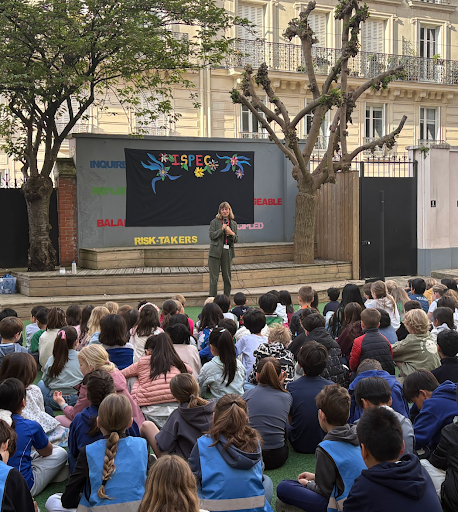
Lending a helping hand with conference prep and delivery, Inspire Citizens’ own Sophie Peccaud is seen here in her ‘natural habitat’ engaging with students outdoors.
Empowering independence
The student-led workshops and presentations belonged to the students. Action CUBS from grades 1 to 5 delivered roughly four sessions each to audiences from kindergarten upward, on worms, on waste, on games that focussed on naming animal sounds and understanding the impact of our waste. Student Eco Leaders proudly wore their green vests and badges that read "ask me about worms." Other topics included plastic pollution in the ocean, reducing food waste, eating less meat by trying vegetarian options, and protecting endangered animals.
Heather and Dan reflect with some amazement that they were often not even in the room when presentations were being delivered. "We weren't hand-holding at any point," Dan says. That was deliberate, and it rested on honouring what students chose. "If somebody's passionate about trees and they want to present about it, then let them do that, because that's how you're going to get the presentation quality. So you can't stunt ideas."
Preparing the adults mattered as much. Sophie delivered a staff workshop the day before which, Dan recalls, “opened everybody's eyes to the genuine rationale behind what we were doing on the day." Heather then made the day itself light for colleagues. "Look, you don't have to do anything,” she recalls telling them. “You can just relax and learn and enjoy. Just, I need you to be the adult in the room." The intentional design of the day paid off in a positive and authentic experience for everyone involved.
Authentic issues from the real world
Heather and Dan agree that that context likely played a role. Paris had a punishing summer and the school has no air conditioning. "The ocean's so far away and the kids didn't have that connection, but heat, we all felt it, and our worms died," Heather says. "It was pretty traumatic. Our plants dried up and the kids could see that."
Dan is clear about where the responsibility sits. "For far too long, it's been the global north that has created many, many of the problems, but shut their eyes to solutions." With grade-appropriate sensitivity, the conference activities offer ways for students to engage in meaningful learning and action opportunities.
Proof arrived at the closing ceremony, when Heather asked who wanted to share what they had learned and the hands kept going up, "from the three-year-olds to the 11-year-olds." For Dan it came in corridor conversations with colleagues who had watched nine, ten and eleven year olds run workshops for large groups. "That made me really proud,” he reflects.
Year two for the conference is already on the calendar, moved to a Wednesday so teachers have two days to unpack it with their students. Heather has a phrase for how they got here, one Dan says she coined: positively persistent.
"What else are you going to do apart from stay positive?" he says. "The kids will feed off that energy."