Year One Check-in: Reflections from a Community Engagement and Service Specialist
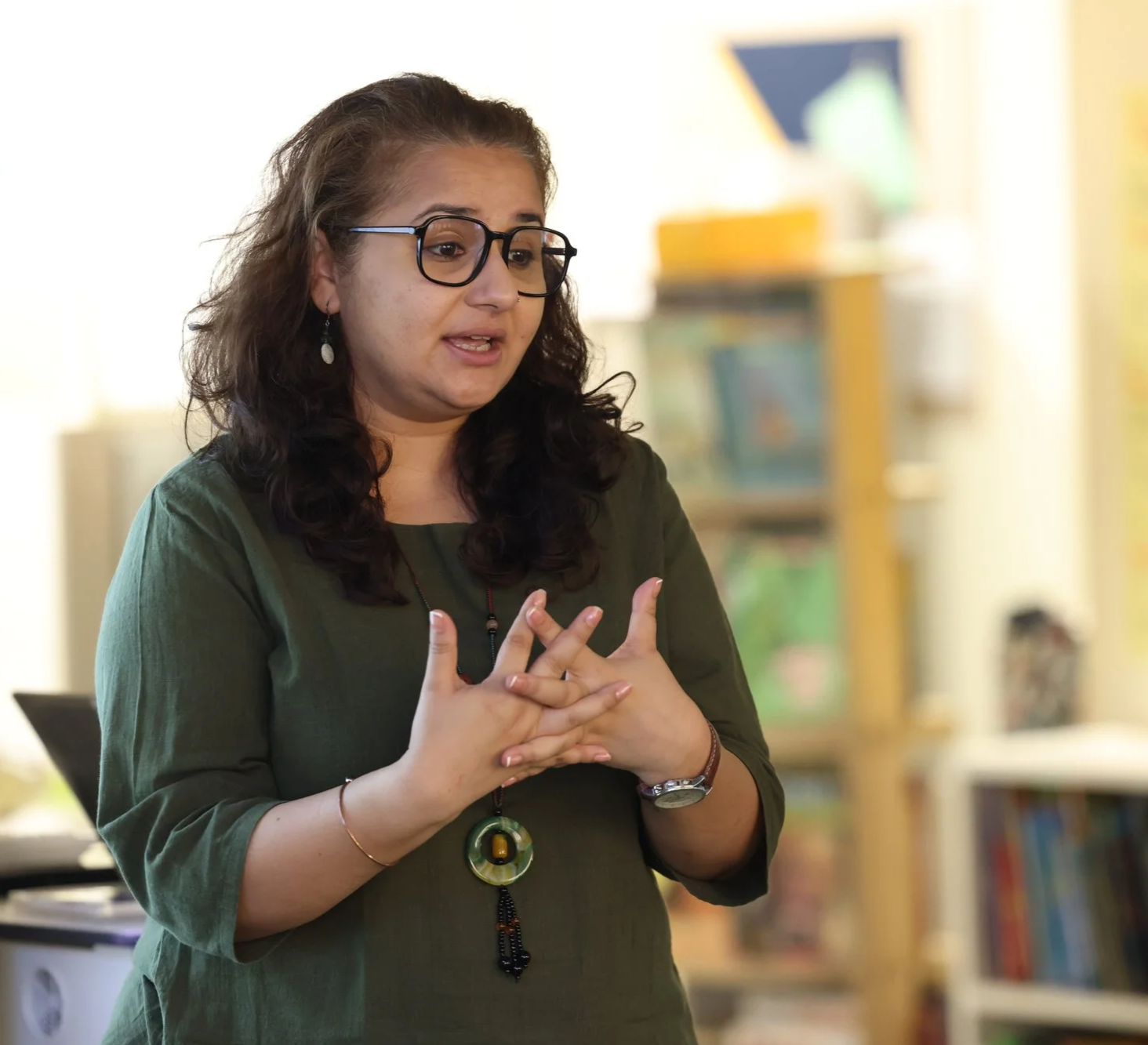
"I needed to be in an environment where there was reciprocity," says Community Partnership and Service Specialist Pallavi Kaushal.
Pallavi Kaushal did not arrive at the American Embassy School in New Delhi by accident. After nearly sixteen years in international development and peacebuilding, she was ready for a reorientation. She had spent a career asking what social change looks like, what youth-led movements can accomplish, and what it means to keep giving when the world’s needs seem to keep piling up. By the time the COVID era unfolded, Pallavi knew something had to shift.
"I needed to be in an environment where there was reciprocity," she says. “I saw the school — working with the very young all the way up to adolescents — as a refuelling opportunity.”
The role that found her, as she describes it, was the Community Partnership and Service Specialist at AES. It brought two halves of herself together in a way she had not anticipated: the daughter of retired diplomats who had grown up moving through international spaces, and the practitioner who had spent years trying to understand what peace actually looks like when it is built from the ground up.
She has been in the role for eleven months. And she will be the first to tell you she is still learning.
A Moral Imagination at Work
The intellectual framework Pallavi carries into her work comes in part from the writing of John Paul Lederach, a renowned peacebuilder whose concept of the "moral imagination" has stayed with her since her graduate studies. Lederach's core idea — that transformation emerges from rearranging what already exists, not importing something foreign — is not just a theoretical touchstone for Pallavi. It is a practical one.
"The moral imagination emerges from what is already existing. You just need to rearrange things,” she insists. “In my work with colleagues, I come from a space of making sure everyone has access to the resources they need.”
It is a philosophy that shows up in how she enters a room. In her first year at AES, rather than arriving with a blueprint, she chose to follow ease. She listened more than she spoke. She went where relationships were already forming and asked how she could help them shine. Her director of teaching and learning had given her a single key performance indicator at the start of the year: build relationships. Pallavi took that to heart.
"I led with curiosity," she says. "I just followed where the flow was easy."
Reciprocity, Not Charity
The word that recurs most often when Pallavi speaks about her work is reciprocity. It is the animating principle behind AES's approach to service, and it is the lens through which she evaluates every partnership and every experience she helps design. “Reciprocity is a vehicle through which the community's values get elevated and amplified,” she says.
One example she returns to is a collaboration with Katha Lab School and Teach India Service Club at AES, in which students from a partner school come to AES to practice their English. The arrangement, on its surface, might read as AES offering something to the community. But Pallavi is quick to complicate that reading. The students from Katha Lab School have, on occasion, corrected the grammar of AES students. The exchange flows in both directions, and that, she says, is the point.
When a Grade 5 class was studying the Right to Education Act in India, Pallavi helped arrange for the school's head boy, a student who had personally benefited from that legislation, to speak. It was not a CEO nor an NGO representative. The spotlight was on a young person sharing his own story to students younger than him.
"There is a level of authenticity that enters," she says, "when storytelling is community-led."
Reciprocity, in Pallavi's framework, is not a program design principle. It is an ethical one. "That's where dignity lies," she says simply.
Support for the Journey
Inspire Citizens, says Pallavi, offered something she did not expect: a language. "Their GCC course offers crucial perspectives on how to work effectively with educators, in a way that complements and elevates their work." For someone arriving from the nonprofit and peacebuilding world, that frame mattered. She is still making her way through the course, steadily and sustainably; the same way she approaches all things in her work.
To further facilitate her career shift, Pallavi welcomes the highly personalized coaching she receives from Inspire Citizens Co-Founder Aaron Moniz. "For someone transitioning from the non-profit world," she says, "Aaron's support in this past year has been invaluable."
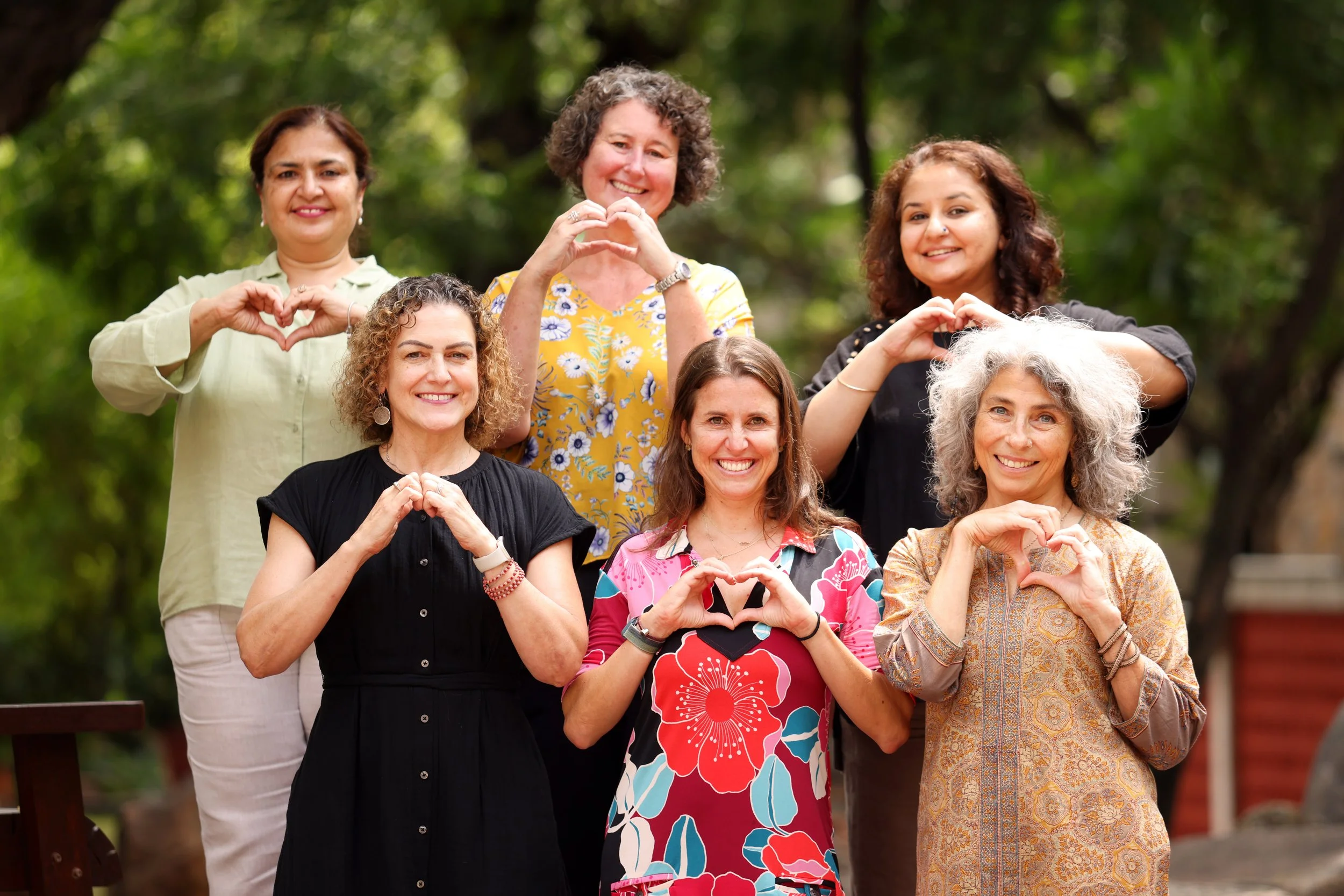
Feeling the positive vibes, the AES Teaching and Learning Centre team is (top row) Rosy Kapoor, Bronwyn Weale, Pallavi Kaushal and (second row) Mare Noble, Robyn Vierra, Diane Ajamian.
Building for What Comes Next
When Pallavi looks to the year ahead, her focus is on sustainability and building a foundation for the long term.
"If I'm not around, do the systems exist for this to continue?" she asks. It is the question she returns to again and again, and it shapes how she thinks about everything from curriculum integration to community partnerships to the storytelling vision she is slowly building at AES.
That vision is ambitious. She imagines a multimedia archive of service at AES — a time capsule, she calls it. The archive would allow anyone to look back and observe how "Enter to Learn, Leave to Serve" has evolved across the school's seventy-five-year history. She wants students to be the storytellers. She wants communities to lead the narratives. She wants the work to outlast any one person's tenure in any one role.
Values, she notes, are not fixed, noting that, “they exist in the gray." The work is to keep holding space for that complexity, keep modeling it for students, and keep building structures that allow them to take root and grow.
"In this moment of time, in the here and now, this exists," she says of AES, "and it's a special place."