Locally Grounded, Globally Connected: Jennifer Ivory's Blueprint for Global Citizenship
In a world where conflict is no longer abstract for young learners, one educator's decade-long commitment to building systems, not programs, inspires educators to meet the moment.
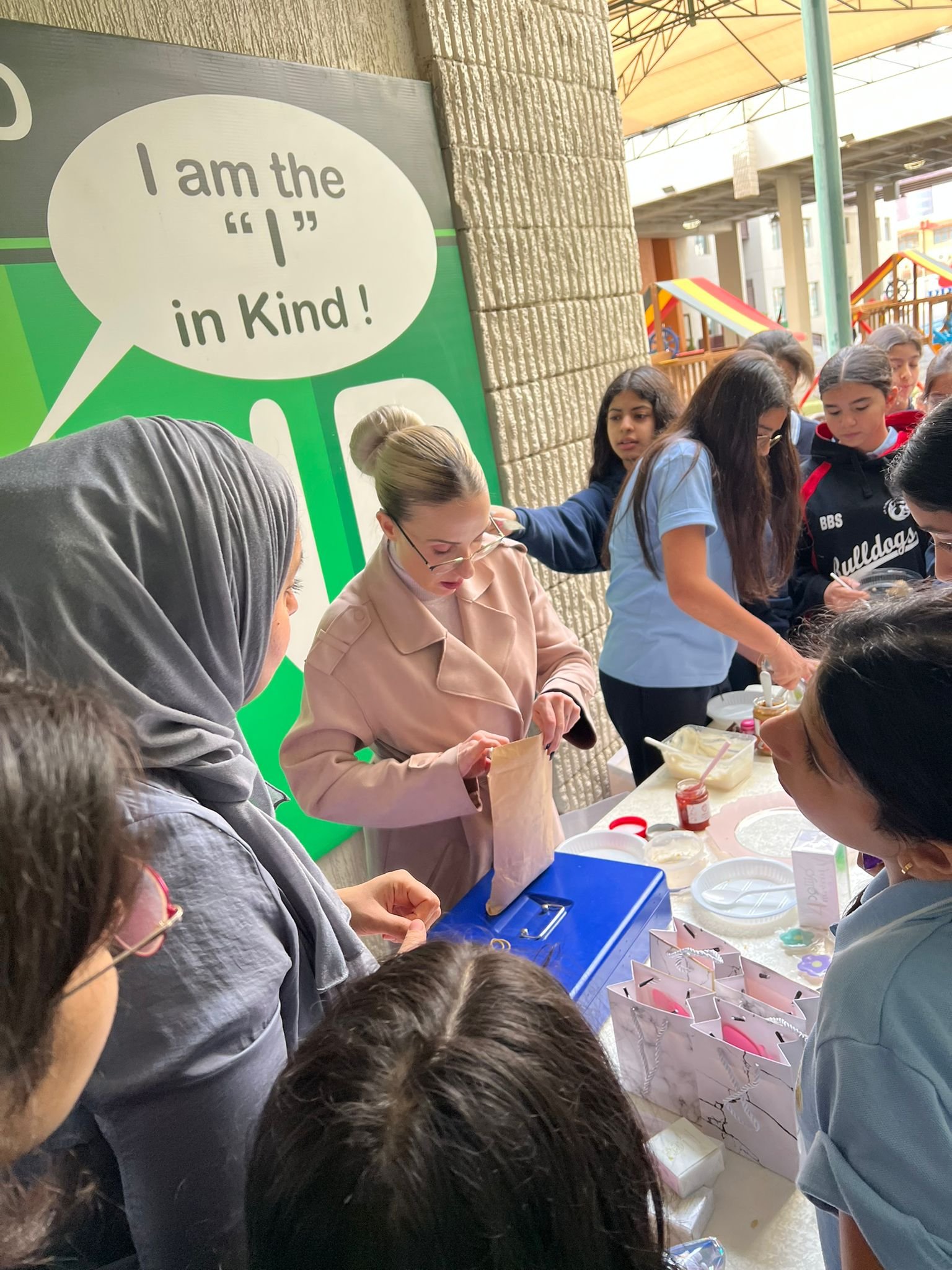
Creating a venue for expressing the traits of a kinder world is just one of the pathways toward Global Citizenship that Jennifer Ivory has promoted. (image supplied)
It is not lost on Jennifer Ivory that global citizenship has arrived on her students' doorstep in ways she never anticipated. Jennifer is the Middle School Assistant Principal and Global Citizenship Coordinator at a bilingual international school in Kuwait, and in recent months she has watched young people in her school community reckon with geopolitical instability in real time. For them, global citizenship is not a concept. It is the air.
"My kids are only 11 to 13," she says. "But I was listening to them, interact with a CIS (Council of International Schools) evaluator and I was thinking, nobody prepped you. Where did you get this from?" What they had was the language, the empathy, and the framework to connect what was happening outside their classroom walls to what they had been building inside it. That, Jennifer will tell you, is the point.
Why Now More Than Ever
Ask Jennifer whether global citizenship is having a moment, and she barely pauses. The answer is yes, but her reasoning runs deeper than current events. She points to a quiet shift happening in homes as much as in headlines: parents stretched too thin, traditional value transmission giving way to socializing and screen time, and schools left holding a far more complex mandate than the one written on the wall.
"We're not just math teachers or science teachers or English teachers anymore," she says. "We're counselors, we're social workers, we're like members of the clergy trying to demonstrate to kids what it means to be a good person." She grew up in Ireland, the daughter of working class parents who were always present despite working in opposite shifts and in challenging jobs. They made time to model values. She worries that time is simply harder to find now. "You have to directly teach these things," she says, "problem solving, critical thinking, resilience. We learned that on the street and in our neighbourhood. Now it has to be taught."
Global citizenship, for Jennifer, is not about producing world travellers or aspiring diplomats. It is about giving every student a vocabulary for their shared humanity. "It's about taking your values that make you you, as Kuwaitis, and making sure you're locally grounded but globally connected."
Seeking Partnership in Building Something That Lasts
Jennifer did not arrive at her current approach quickly. She arrived at it systematically. Over nearly a decade at her school, she has worked to reduce what she calls "initiative fatigue," the weary recognition among teachers that every new thing added to the plate will eventually be joined by another new thing. Her response was to stop adding programs and start building infrastructure.
Central to that infrastructure has been her partnership with Aaron Moniz and Inspire Citizens. The relationship began through a formal school agreement, with Jennifer serving as the liaison. But it became a professional connection considerably more layered than a procurement arrangement.
"Aaron is just invaluable," she says. "It was really hard for me to secure funding for Inspire Citizens at the outset, but once the work began, I was able to prove that I wasn't buying a program. I was retaining someone to help me build a system." The distinction matters enormously to her. A program depends on the person running it. A system outlives them.
The partnership worked on multiple levels simultaneously. Aaron ran workshops and facilitated student leadership conferences. He coached curriculum coordinators. And in quieter moments, he played a role that Jennifer describes with characteristic directness: "With me, one-on-one, he's a coach. He's a mentor. Because he's been in our school community, he understands the context." When Jennifer hit the walls that every change-maker eventually hits, Aaron was on the other end of a voice note. "I would call him and say, I give up, I'm doing it all wrong. And he says, ‘Start again. Where are you going wrong?’” She invokes the story of Sisyphus, then notes that Aaron helped her find a version of Sisyphus who, over time, discovered something worth showing up for.
There is something else she values about the Inspire Citizens relationship that goes beyond strategy. "You never feel like they're a consultant," she says. "After all this time, Aaron's a friend. I didn't have to be overly formal; his voice notes, that kind of constant support if needed." She encourages any school considering the investment to make it: "The framework is public. But having someone help you build the system inside your specific context, that's what changes things."
EmpowHer: When Global Citizenship Gets Personal
Among Jennifer's proudest achievements at her school is EmpowHer, a girls-only empowerment club she founded and has since had legally established with the school's support. It began as a survey. Girls across the school were asked what they felt was missing. Their answers shaped everything that followed.
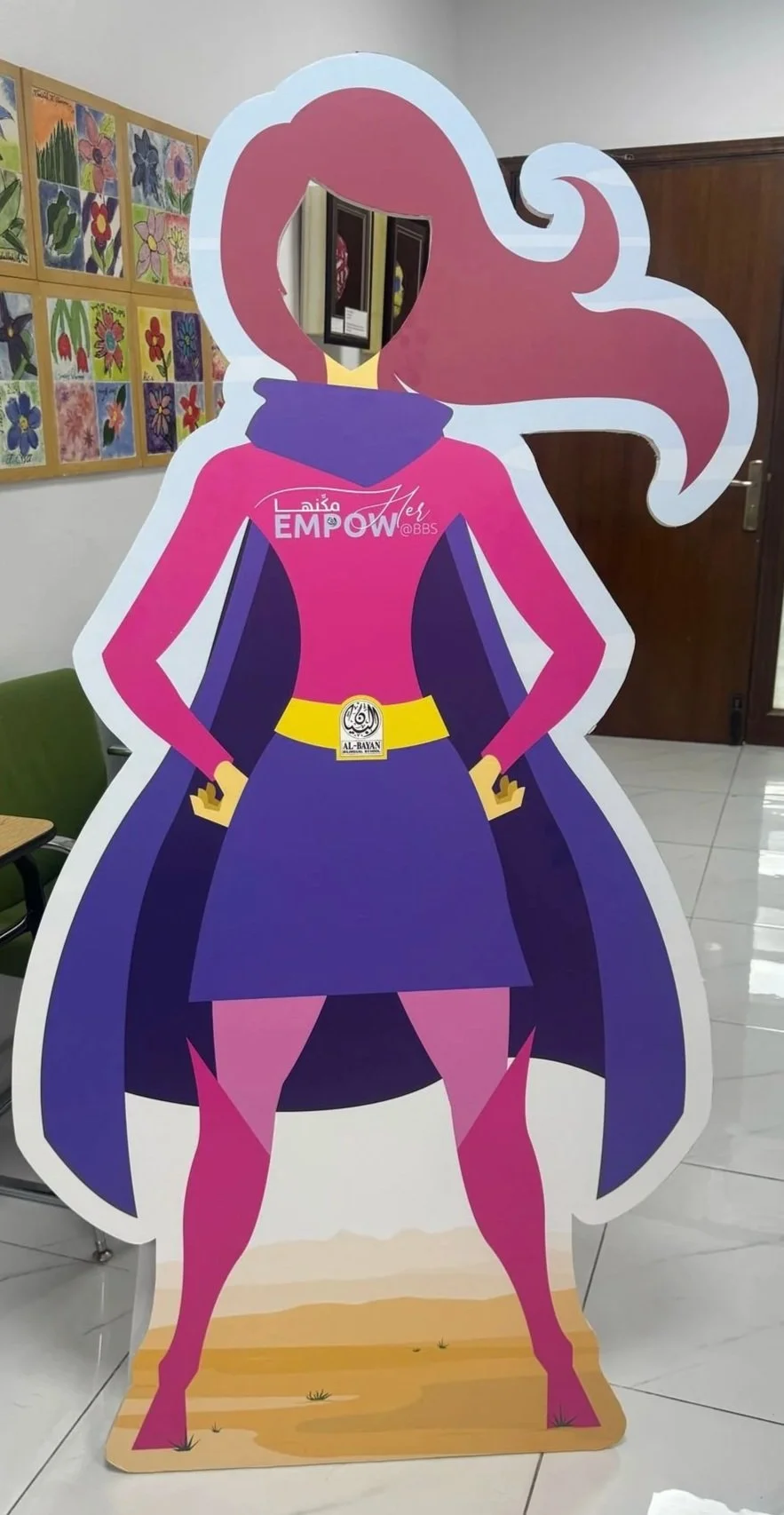
Artifacts of empowerment remind students and community members of the agency they have in creating a better future locally and globally. (image supplied)
One initiative stands out. In a country where access to menstrual hygiene products is largely absent from public spaces, Jennifer's girls fundraised, sourced, and installed dispensers in the school bathrooms. "There's one mall in the whole of Kuwait that has one dispenser," she says. "My girls raised the money, they got them, they put them in the bathrooms.” Some encountered resistance at home but persisted in making the case for involvement.
The word the girls kept reaching for, without quite landing on it at first, was dignity. And shame. Jennifer helped them name it. She also helped them act on it, co-creating bilingual booklets in Arabic and English for younger students, partnering with local sanitary businesses, and holding an all-afternoon education event on female health in a context where such conversations rarely happen at all. "My girls did all that," she says simply.
As Jennifer transitions to a new school in Kuwait, EmpowHer will remain at its home, taken over by a colleague and friend, and positioned to expand into a charter model across the Gulf. "My friend will fill me in on what's going on," Jennifer says, "and they know they can call if there's any issues." It’s an example of a system ensuring that a concept remains viable past the departure of certain leadership figures.
Advice for the Road
Jennifer is characteristically practical when asked what she would tell a Global Citizenship Coordinator starting from scratch. Her first piece of advice: build your monitoring systems before you build your programming. "How are you going to know this is successful?" she asks. "Build your impact measurement systems first and work backwards from there."
Her second piece of advice is about people, specifically which people. "Find your early adopters quickly, and make sure they have social capital," she says. "Not just the good teachers, not just the ones who say, oh my goodness, this is beautiful. Do they have social capital with the rest of the staff? Because if they don't, they’re going to be on their own.”
Jennifer’s closing image is one she uses with school leaders: a dinner plate. Write down everything teachers are currently asked to do. Stack those imaginary post-its on the plate. Then ask honestly: what comes off before something new goes on? "It's not about adding more," she says. "It's about being different."
Jennifer Ivory is not quite done with her current school. She has a few more weeks, a system to hand over properly, and, somewhere in there, a wedding to get to. But she is already thinking about what comes next and about a blank canvas that rarely presents itself mid-career. "I know all the mistakes I made with this," she says. "And how I can make it even better, more successful."
She pauses, then adds something that could serve as both a personal motto and a rallying call to any educator wondering whether the work of global citizenship really matters. "If I can't get through to the kids by talking to them one-on-one, I can at least build a system that's going to help them become who they need to be for the world they're going to go into."