The Inspire Citizens Odyssey: A Look Back at the Story that Shaped Us
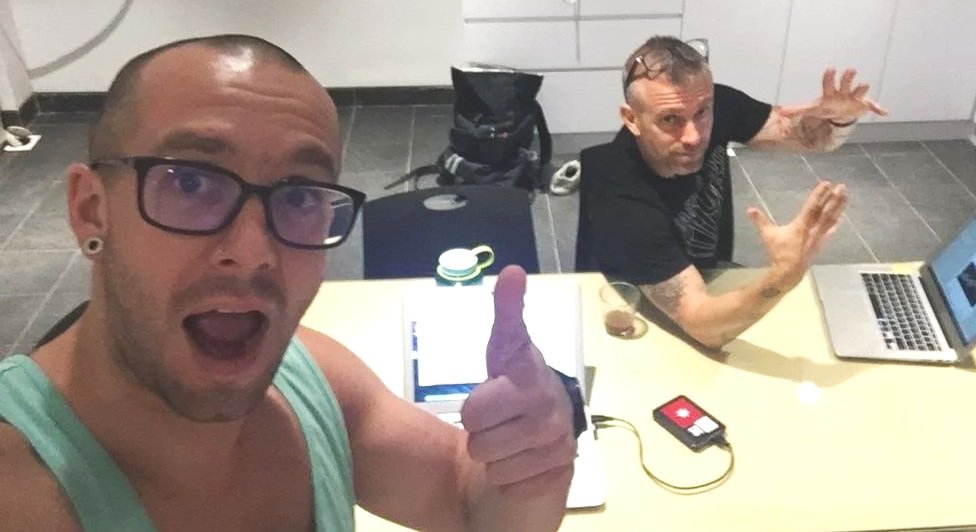
Inspire Citizens began as collaborative colleagues who became friends before their ultimate transformation into edupreneurs.
Aaron Moniz starts the story somewhere comfortable.
"Imagine a very fulfilling, great school, with great services," he says, staring at a distant point of memory. "Steve running spin classes, me training triathlon, coaching all the coolest sports teams, great facilities, swimming and running and playing in punk rock bands around China. We had the golden ticket. We had so much. But it was hard to shake off the idea that something was missing."
It took him and his good friend and colleague, Steve Sostak, a while to say it out loud.
"Even though we thought we had all of our hearts' desires in place, Steve and I couldn't confidently look at each other and say that we were doing our best to have the biggest impact in the world that we wanted to,” says Aaron. “We were doing a great job with the eighty kids in our classroom. But when we looked around and talked about global citizenship education, or service learning, or meaningful community impact, or addressing bias, or working with communities sustainably, that wasn't a key conversation that was happening. And we realized that's not okay."
He offers an honest assessment of his life at that point: "Having all the good things in the world isn't worth anything if you're just contributing to a recurring instance of negative things happening in the world. If we could do anything to jam a stick into the spokes of that wheel, or disrupt a system that wasn't working, it was worth giving it all up and going for it with everything we had."
The perfect moment in the turning of the wheel came at a combined Model UN and Global Citizenship conference in Shanghai, where he and Steve were working with the junior storytelling team.
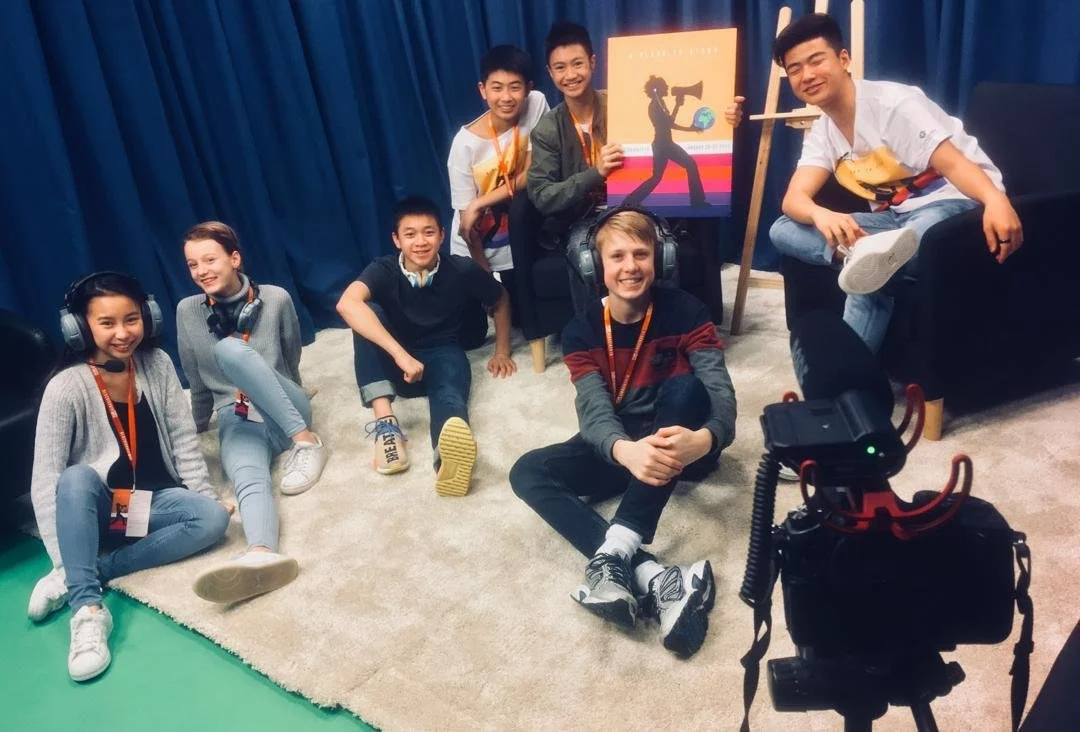
Aaron cites the moment that IC was born: he and Steve led a team of students to a weekend MUN/Global Issues conference. They looked around at the dynamic engagement of the students and agreed, “This could be school.”
"We're looking around this conference, seeing these amazing speakers, amazing student action groups, amazing journalism and media groups, seeing the joy and the engagement and the commitment behind everyone involved. And Steve and I looked at each other and said, ‘why is this a weekend workshop? Why is this a one-time event, for those who can attend? As much as this is beautiful, this could be life. This could be school. And why is it not?’”
Aaron was inspired. Steve moved first.
Setting out on the journey
"It was really Steve who came back to me on Monday and said, ‘I’m doing this. I'm quitting my job. I'm putting in my resignation by the end of the week. If you don't join me, that's fine, but this is what I want to do,’” Aaron recalls Steve adamantly saying. “Steve was clear, ‘This is what we've been talking about forever. So let me know by the end of the week, because I've already written my letter. Are you in?’”
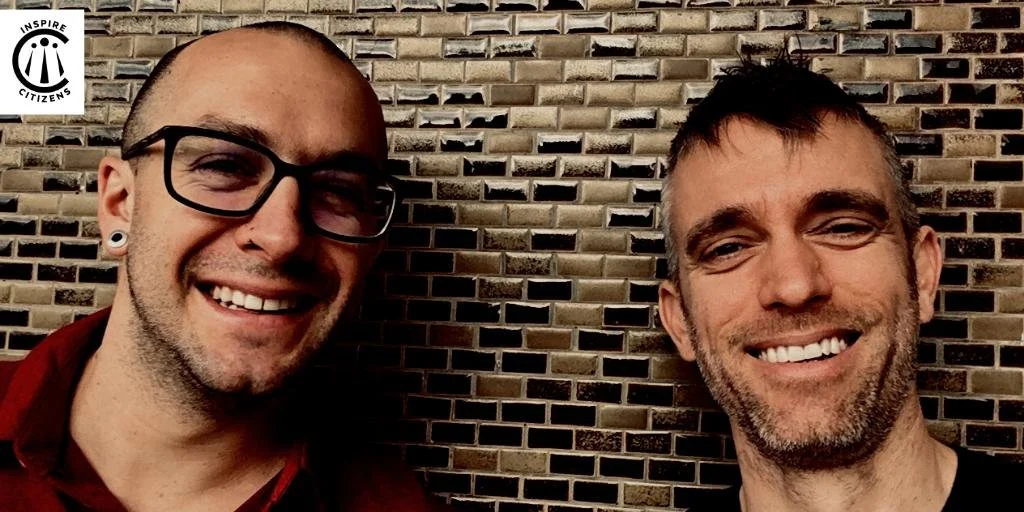
The fresh faces of Inspire Citizens set out on a journey to change the world of international education.
Aaron took two days, though he says the outcome was never really in doubt: "It wasn't really thinking about it. It was more of taking the cobwebs out of my mind and making sure I was listening to my heart, because I already knew what the answer was."
He is candid about what they were leaving. "We were at a truly great school, so departing meant saying goodbye to some things. Stability, especially. Steve had a family, including two daughters, with one in college. I was in a relationship where financial responsibility was important for us. And we were so good at teaching, and all of a sudden we weren't going to be doing that anymore. It was leaving a realm of comfort and professionalism and identity,” explains Aaron.
And in place of what they were leaving behind, Aaron and Steve carried a sort of mantra that they made a habit of repeating to each other: "Do good things, and good things will end up in your path."
The pull to turn back
The temptations came early and kept coming.
Aaron invites us to picture the early success. “Imagine eighteen months in, we’re finally almost earning the same amount as we were in a previous job. And the pandemic hits. All funding for the work we do is suddenly taken away." For a while, going back looked like the responsible choice, reflects Aaron. Steve and I both asked ourselves, ‘Do we go back to full-time jobs for a little while, so we can have some stability?’ But luckily, one of our key partners honored a big contract, and we were able to live frugally to make the team payroll.”
Prompted to recall other possible termination points of the early IC journey, Aaron remembers even sooner: "Early on, before the pandemic, another organization talked about a merger or acquisition. At the time, that was a very attractive consideration." Despite the attraction of stability and continuing work opportunities, the partners took a dim view of that route. "We weren't ready to merge our vision with somebody else's vision for financial security. We decided that the two men who started this journey would be the two directors who would continue to guide the ship, regardless of the possible perils and instability."
Straight through
Ask Aaron for the hardest crossings and he names two.
The first was the pandemic, not as a scare but as a business model that stopped working. "How do you advance at something you built on an in-person, professional-development model for schools, when now travel isn't possible and nobody has PD budgets?,” he asks retrospectively. “How do you completely shift your business model while still sustaining revenue for a team of four?" Turning away from images of disaster, the two shifted the Inspire Citizens trajectory. "We built our online courses, our virtual coaching, and some online tools that became lead generators. And once travel came back, we had actually tripled our business, because we had more to offer, more capacity, more services,” Aaron explains.
The second, and most unimaginable peril he approaches carefully. Steve passed, and the shape of the whole thing changed.
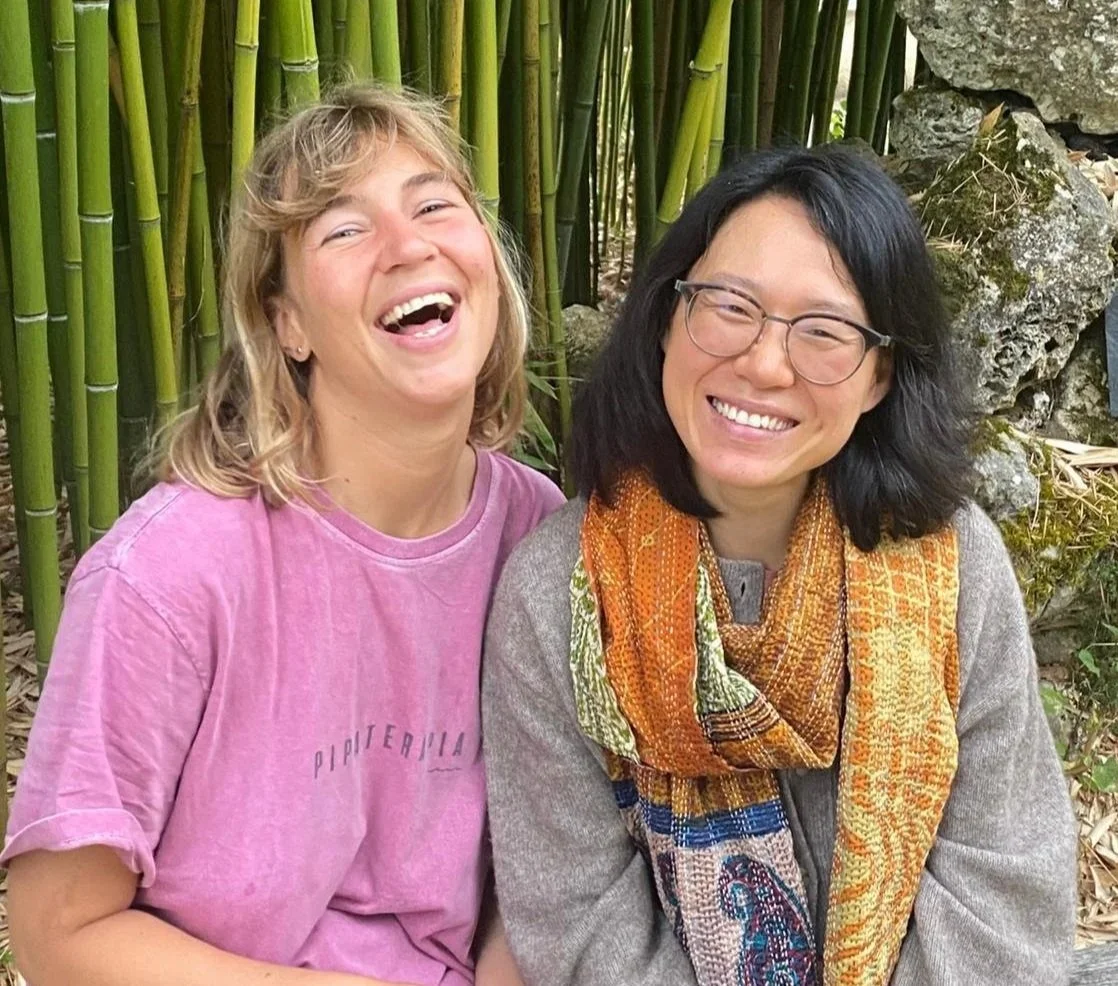
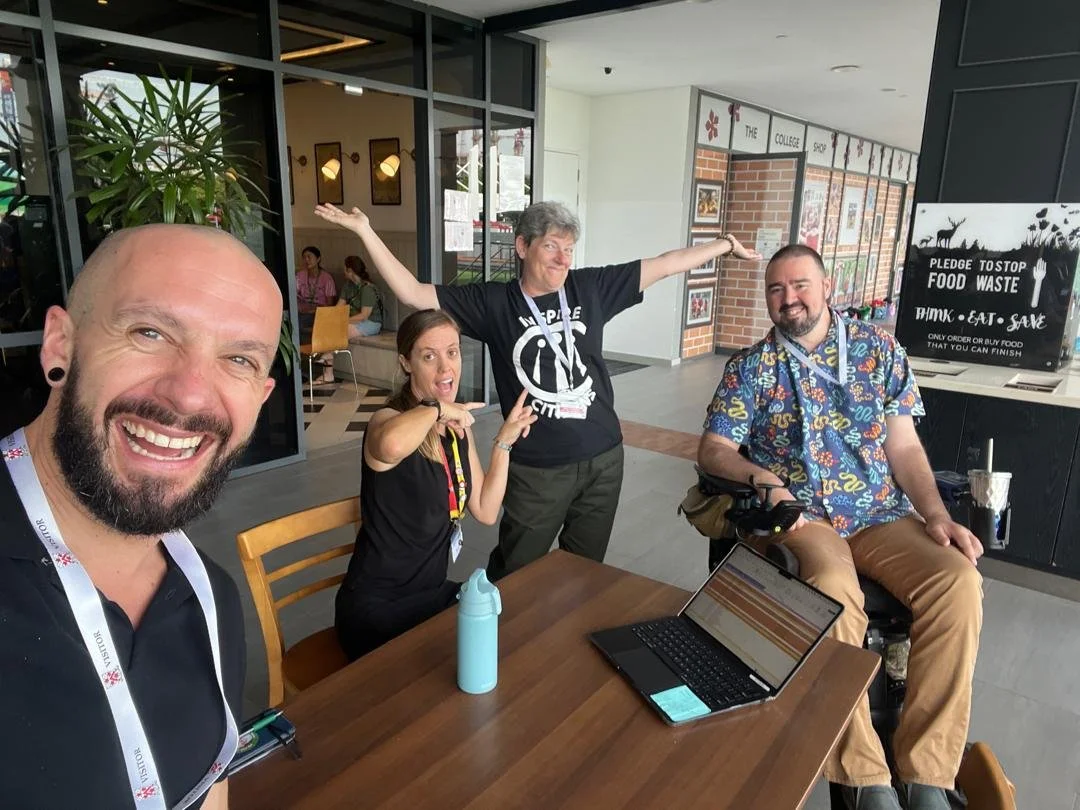
Experiential Learning Facilitator Ivy Yan, a vital component of IC’s original success, shares a light moment with Partnerships and Student Leadership Specialist Sophie Peccaud.
"There's two people on a journey, two people who were directors, captains of a boat, and now there's only one,” Aaron says. “It means one person has to steer, with the help of the crew. And maybe one person's navigation methods, ways of running a ship, have to change, and the crew has to adjust." What did not change was the decision to keep going. "There was no way we were going to let the ship go down. It was all hands on deck, do what you need to do, believe in the mission. Everyone was amenable to giving it six months of going hard. And once we've made it through the storm, we'll set sail in the safest direction, with a renewed vision for the remaining crew."
The crew
What he returns to, talking about those months, is the crew.
"Our internal team really rose to the occasion. It didn't matter if it was making public announcements or helping with memorial services. Some of them said, it's okay, Aaron, I've got this, you don't have to think about this. Others said, don't worry about money right now,” he remembers fondly. “What's most important is health, family, and making sure the mission goes forward."
The help came from outside too. "The amount of people Steve had impacted meant there were so many who wanted to assist, wanted to find a way to give back, and wanted to continue supporting our vision." Inside the organization, roles dissolved and re-formed. "Everyone had to be okay with shifting roles,” Aaron recalls. “And even our partner schools, if they'd been working with Steve, would say, ‘You know what? Aaron, you should come instead.’”
Who showed up
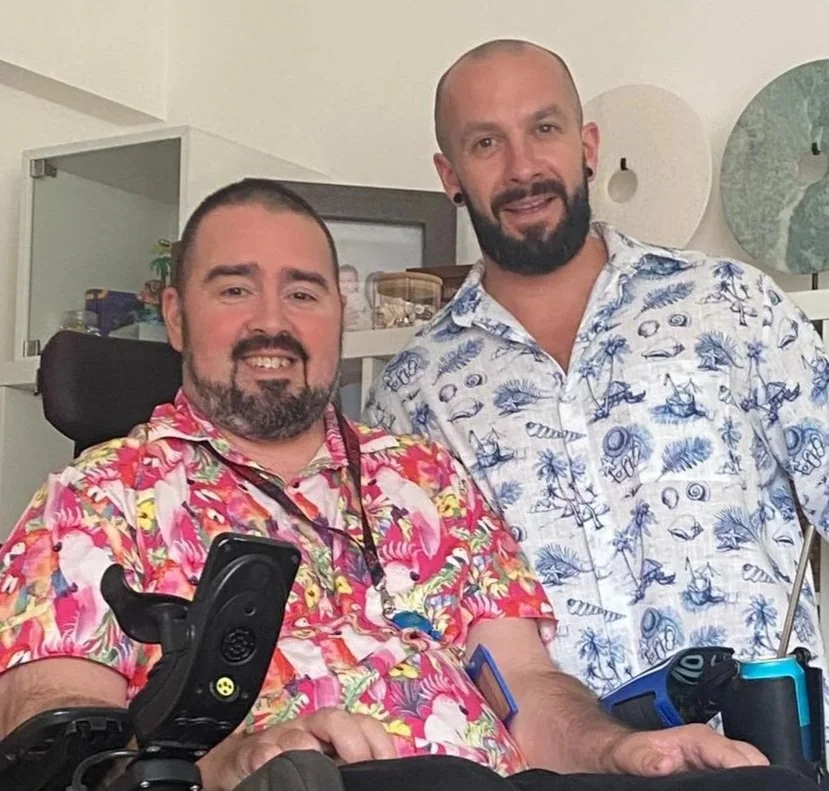
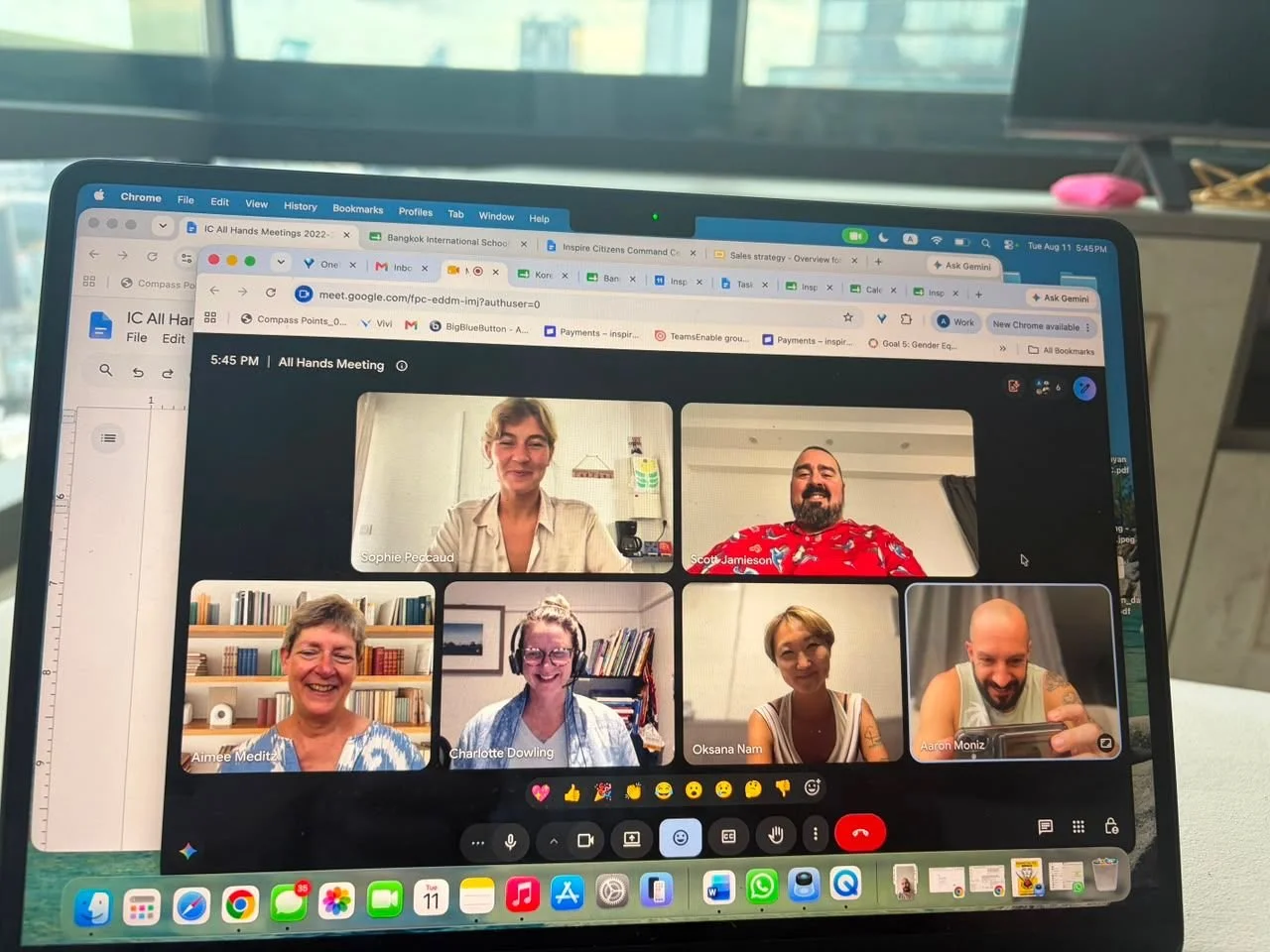
Global Collaboration Lead Scott Jamieson shares top level partnership duties with Aaron Moniz as Inspire Citizens continues to connect educators through podcast media, online workshops, and both virtual and in-person learning experiences.
Asked who arrived at the right moment with the right word, Aaron gives two answers, and the first is not a single person.
"It was an overwhelming response from everybody. Please join this conference. Here's a new contract. Come work with our school. It wasn't one person, it was hundreds of people reaffirming our direction,” Aaron remembers. He recalls the messages kept pouring in, in one form or another: “Keep this going, because the world needs Inspire Citizens.”
The second answer is one person, his partner Jayhyu, who told him something he needed to hear: "She helped me realize that the way you've always done things isn't always the right way, and you have to be willing to change. Anything that sacrifices too much of yourself isn't going to lead to sustainable impact over time." That reshaped how he ran the organization. "She helped me understand that there are revenue models that can sustain the organization without it being at the expense of your own well-being."
The proof
He can point to when the idea of IC stopped being an experimental concept and transformed into a valid and worthy venture. Working with a school in Seoul, they had turned their focus to student voice and student evidence.
"When we could see that a five-year-old, an eleven-year-old, a middle schooler was finally embodying that type of thinking, that empathy, that community awareness, it was no longer an idea in our minds. It was literally being spoken and enacted by hundreds of students in a place we were investing in."
The other kind of proof-of-concept was slower and quieter to be realized, recalls Aaron. "We became members of the family for many school partners. We were not a team of consultants. We were not two dudes who flew in to do a bit of work. It became a conversation where our partners told us, ‘here's what I want for the next steps of our relationship. Here's what I'd like to invest in together over three to five years. When people took us in as essential members of their school community, because there's trust, and mutual goals, that's when we knew we were doing the right things."
Home
Ask Aaron what home looks like, if Inspire Citizens is sailing toward one, and he laughs at himself before answering.
"This is the most third-culture-kid answer you've probably heard, but there is no home. There's only a world of interconnected people,” he insists. “There's no destination other than making sure that all beings on this planet are better, healthier, safer, more harmonious, more interconnected than they were a few strokes back. The journey is the home. The earth is our home. As long as we're able to contribute positively, we are home."
Aaron’s voyage changed him along the way. "This experience brought me from being an educator to an edupreneur,” he says. “I didn't know a whole lot about running an organization, and now that's so much of what I do, based on a foundation of pedagogy." The deeper change was in how he works. "I always believed in myself and was committed to results, in music, sports, academics. But I'd never invested so much in an ambiguous thing that I wanted to shape and create. Before, there were always steps, and I was great at following the steps. Now I've become a creator, somebody able to invest in a vision and materialize it alongside the most incredible team members you will ever meet.”
Inspire Citizens changed too, into something more deliberate than it began. "IC has become a strengthened neural network. It's not about doing a lot of things,” he insists. “It's about doing a few things in a unique way, very well and very deeply. They're all part of an integrated system that brings people back to our ultimate goal, which is the most effective whole-school systems for global citizenship, because that's the surest way to systematically reach as many people as possible."
See how Inspire Citizens is having a global impact by browsing our extensive gallery of Vignettes.