A Different Kind of Wednesday
At Al-Rayan International School in Accra, a Year 6 teacher infused the PYP Exhibition with Inspire Citizens’ Empathy to Impact model. Her students turned a question about mental health into a policy that changed the school calendar.
On the first Wednesday of every month, students at Al-Rayan International School in Accra go home without homework. They’re free to pursue hobbies, interests and wholesome activities as they and their families see fit. On a calendar, the change is small, one day in thirty, but what it represents is not small at all. The decision did not come from a staff meeting or a leadership retreat. It came from a group of students aged ten and eleven who set out to understand mental health and refused to stop until something changed.
The students were part of the Year 6 class of Dorcas Addo, who guided them through the Primary Years Programme Exhibition, the culminating student-led inquiry known as the PYPx. Working alongside Scott Jamieson, Global Collaboration Lead at Inspire Citizens, Dorcas supported the work of students pursuing that familiar milestone as they uncovered something more personal and more powerful.
A Blend of Approaches
Rather than adopting a new framework wholesale, Dorcas merged the school’s existing inquiry cycle with the Inspire Citizens Empathy to Impact model. She reframed the journey as three interconnected movements. “We came up with the heart, mind, action,” she says. “We wanted to make sure that kids are fully invested emotionally—that they genuinely care about what they are learning. That is at the heart of it,” she says. “That is the care part.” In her learning cycle, care comes first. When students care, they become more open to developing understanding, and from that combination of care and understanding, thoughtful action can emerge.
The tool that made the difference was a self-audit and a heart-mapping exercise that Scott introduced. Before choosing a topic, students took stock of their own strengths, talents, and skills, then mapped those against the problems they noticed around them. This way of connecting students’ talents and skills to a topic makes a significant difference,” Dorcas says. “When we bring the focus back to the students themselves—helping them recognize their strengths and consider how they can use those strengths to make their work more impactful—it becomes more meaningful to them.” This shift transformed topic selection from simply following a friend’s choice into an opportunity for students to make purposeful decisions and genuinely take ownership of their learning.
Dorcas front-loaded that sense of purpose through pre-exhibition sessions. Students looked around on their way home from school, considered their home cultures, and scanned their own campus for problems worth solving. By the time they chose a topic, they already understood that the exhibition experience meant taking real action to make the world better.
Engaged in inquiry
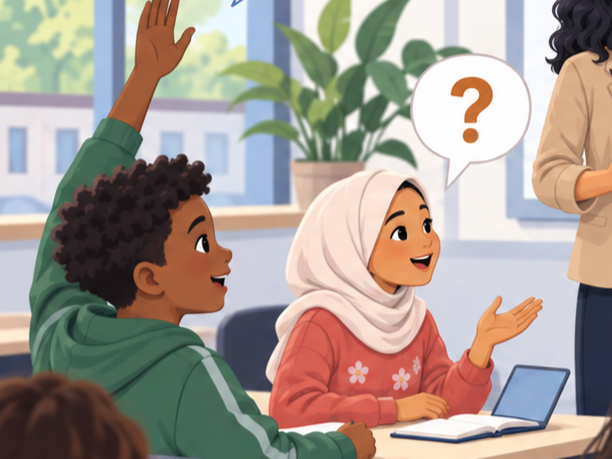
For one group, the topic was mental health. Some students chose it for personal reasons, wanting to understand their own experiences and find ways to help themselves and others. They gathered around a table, wrote down every question they had, and sorted those questions into lines of inquiry. “It was so rewarding to step back and see how deeply engaged they were and how passionate they were from the very beginning,” Dorcas says. Guided by a research structure that encouraged students to draw on a range of sources—including media, interviews, surveys, and observations—they began to investigate their questions. “The structure provided guidance, but the students were in charge,” Dorcas says. They had the support and direction they needed while still having the freedom to take ownership of their learning and lead the inquiry themselves.
One of the students’ own questions set everything in motion. They wanted to know what was causing mental health issues for students in their school. A survey went out, and the answer came back clearly. “They learned that homework was the number one cause of mental health issues for students,” Dorcas recalls.
The students’ first instinct was to go straight to the principal and ask for homework to be cancelled. Their mentors held them back, not to slow them down but to strengthen their case. A survey on its own was not enough. So the students returned to research to discover articles and examples from other countries. They organized their research findings alongside the survey results and only then requested a meeting with the principal, Madame Yvonne.
The real-world experience
What happened in that meeting surprised even their teacher.
“I didn’t utter a word,” Dorcas recalls. “And they would not give up. They persisted.”
The students presented their case with evidence, pointing to examples of schools in other parts of the world. Their confidence and determination went far beyond what Dorcas had witnessed during their preparation. “That day, they were so confident and so persistent. I was amazed,” she says. “They tried to convince Madame Yvonne without a single word from an adult. They knew what they were fighting for.”
The principal did not cancel homework outright. Al-Rayan is a school with an established homework policy, so the question went to the leadership team. When Madame Yvonne returned, she brought a compromise that honored the students’ evidence: no homework on the first Wednesday of each month. “It was beautiful,” Dorcas says.
The response from the wider community has been warm. Some parents laughed when students first claimed that homework was affecting their wellbeing, as though the idea sounded far-fetched. Once the policy took effect, that changed. “It has been received on a positive note,” Dorcas reflects. “I haven’t had any parents fighting it.” She notes that, alongside parents, the teachers appreciate the break as much as students have.
The enduring outcomes
For Dorcas, the deeper win is one that outlasts any single project. The approach has become an annual cycle, and it held even in a year when the Inspire Citizens team members were not on hand to guide it, because the foundation was already in place. “This was one of the powerful tools that I think Scott brought,” she says, “so much so that we, as teachers and mentors, felt deeply empowered ourselves.” And as Dorcas is appreciative for Scott’s support, she is pleased that the embedded practices continue to influence ongoing teaching approaches.
The change on the calendar remains modest as it is constrained to one Wednesday a month. What stands behind it is a class of students who learned that care, backed by evidence and carried with persistence, can move an institution. It is the kind of outcome a teacher keeps close, a reminder of what young people can do when the learning is truly placed in their hands.