PHASE 5
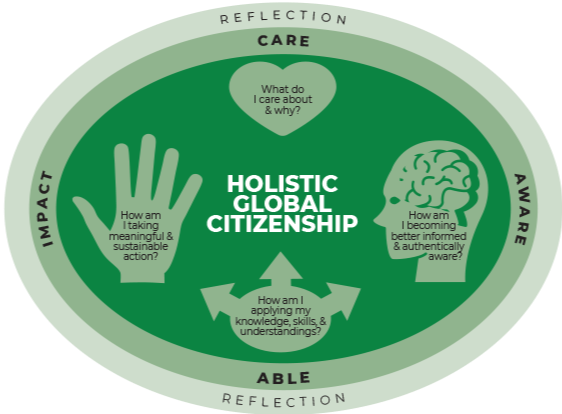
Framework graphic showing “Reflect” embedded between each stage of the Empathy to Impact process, illustrating ongoing reflection, metacognition, continuous improvement, and alignment with school mission and values.
Q: What will we reflect on, and how do we know that we are developing global citizens?
The REFLECT phase is an essential bridge between learning and meaningful action. In this stage, learners engage in thoughtful self-assessment, peer dialogue, and feedback from community stakeholders to deepen understanding, consider diverse perspectives, and refine their purpose. Reflection helps students connect their knowledge, values, and emotions to the real-world challenges they are addressing, building the self-awareness, empathy, and critical thinking needed for sustained impact. Reflection should occur at each step of the Empathy to Impact process, not just at the end. Informed and meaningful feedback and reflection throughout the process ensures that student projects are iterative (responsive and sustainable) and not projects that are static or one-off experiences.
REFLECT Steps:
Step 1: Determine what students will reflect on
As an educator team, determine if students will be reflecting on your school-wide learning outcomes, graduate profile, competencies, learner profile attributes, ATLs (Approaches to Learning), service learning outcomes, or develop reflection questions linked to your school’s mission statement.
Step 2: Determine how and when students will reflect
Will we use a physical journal, create a vlog, or use a website, slide deck, or portfolio? Or will we use a combination of these approaches to capture student reflection and growth? Please remember to choose an approach that is engaging, not overly burdensome for students or educators, and is aligned with reflection, assessment, and reporting practices already used at your school, where possible.
Going Further:
Involve stakeholder and peer feedback:
Facilitate structured opportunities for learners to receive and reflect on feedback from peers, teachers, and community members or experts. Use tools like reflection rubrics or video responses to make reflection actionable and visible.Integrate journaling, discussion protocols, and formative self-assessments throughout the unit, not just at the end, to help students track their growth in empathy, skills, and project impact over time.
Encourage students to revisit their initial inquiry questions or intentions based on new insights or challenges encountered. This supports adaptive thinking and ethical decision-making in their path toward impact.
Considerations for Co-Curricular or Experiential Learning Circumstances
In curricular contexts, reflection is often aligned with your curricular learning outcomes, as well as your school-wide learner outcomes, graduate profile attributes, or approaches to learning. In co-curricular contexts, we may have more flexibility, or we can leverage those same school-wide outcomes, to support students in engaging in meaningful reflection.
When working with student clubs, student leadership groups, after-school activities, or advisory programs, we often focus on student action but do not always guide students to reflect on why they are doing what they are doing. We need to ask:
•Is their action having the intended impact according to their mission statement?
•Is the student leadership experience shaping the kind of individual we aspire to develop as a school?
To deepen co-curricular reflection without overburdening students, embed quick, engaging activities into:
•Club meetings or advisory exit tickets
•Student leadership tasks
•Non-text-based prompts (e.g., one-minute video reflections, digital polls, graphic organizers)
These bite-sized reflections (60 to 90 seconds) allow students to surface their growing self-awareness and agency.
In experiential learning contexts, too often, trips lack an overarching inquiry question. If one is set from the outset, we can scaffold reflection at key moments. For example, at the end of Day 1, after conducting a biodiversity audit or interviewing community members, give students a few minutes to reflect:
•What did I learn?
•How has this changed my perspective?
•In what ways did engaging respectfully with this community help me live out a school-wide learner outcome or graduate profile attribute?
Keep these reflections quick, intentional, and student-centered, so that both the experience and the learning truly happen. Without this pause for reflection, we risk the trip becoming mere activity rather than a meaningful step in students’ growth toward our school’s mission and vision.
Further Reading
Experiential learning and the power of meaningful reflection
Experiential learning weeks like this have significant potential to connect academic learning from a variety of subject areas, and to help students push the boundaries of their comfort zones when it comes to being in new situations and learning about themselves, others, and environmental systems and challenges… (Read more…)